
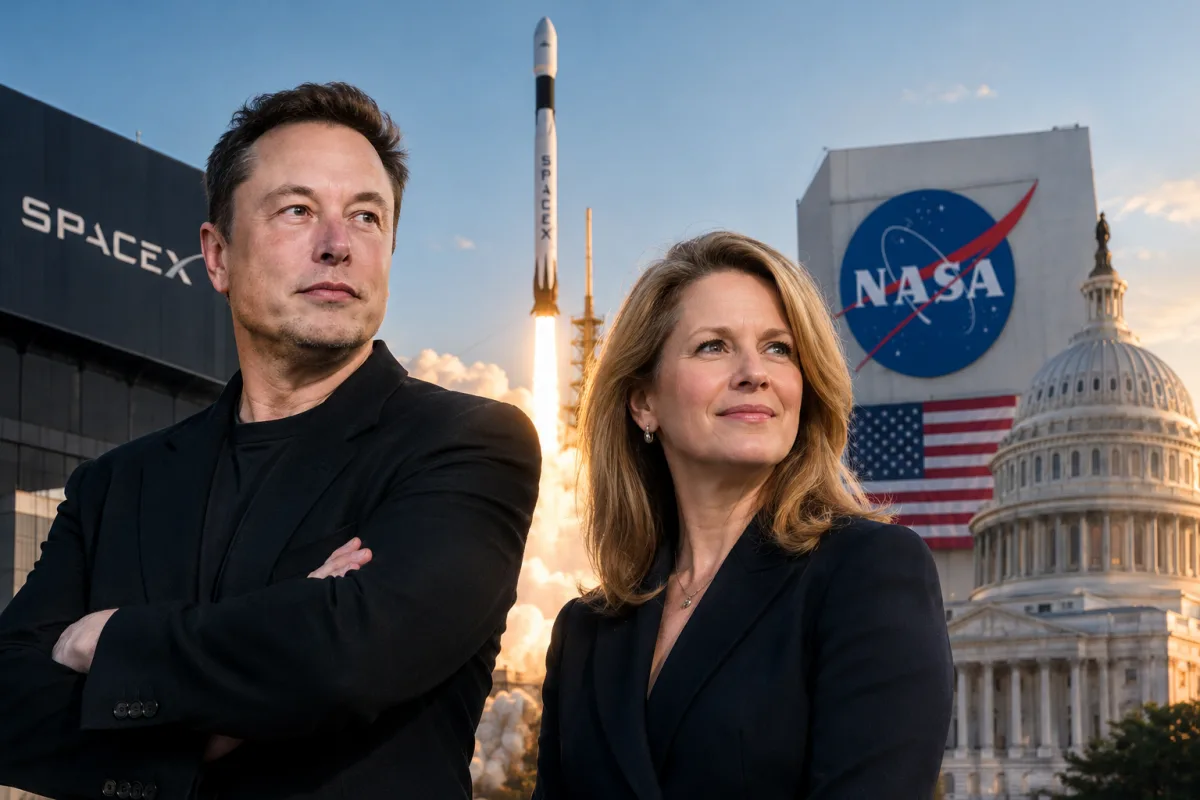
For nearly 25 years, Elon Musk and Gwynne Shotwell, his key partner at SpaceX, viewed the United States government as a major opportunity for growth. Much like the legendary city of gold known as El Dorado, government contracts represented the potential to build a powerful and profitable space business.
Building that business was far from easy. SpaceX had to compete against established aerospace giants such as Boeing and Lockheed Martin while navigating complex regulations, government procurement procedures, and intense competition for contracts. Despite these challenges, Musk and Shotwell gradually established the company as a major player in the American space industry.
SpaceX challenged traditional aerospace companies, disputed government decisions when necessary, and pushed for a more competitive contracting system. Its strategy focused on delivering reliable space technology at lower costs, helping the company secure important contracts with NASA and the US military.
Over time, these efforts transformed SpaceX from an ambitious newcomer into one of the most influential companies in the commercial space sector.
How SpaceX Became Essential to the US Government
As SpaceX continued to win major contracts, its relationship with the US government began to change. Initially, the company depended heavily on government customers to finance its growth and establish its reputation. However, as its rockets, spacecraft, and launch services became increasingly important, the balance of power gradually shifted.
SpaceX is now a critical provider of launch services and space transportation for American government agencies. Its Falcon rockets and Dragon spacecraft have played important roles in NASA missions, including transporting cargo and astronauts to the International Space Station.
This growing dependence has created a different dynamic between the company and its government customers. SpaceX is no longer simply competing for opportunities within the federal contracting system. In several important areas, it has become a provider whose services are difficult to replace quickly.
Why SpaceX May Be Rethinking Government Contracts
Despite its success, SpaceX appears increasingly focused on opportunities beyond traditional government contracting, particularly in areas where commercial demand offers significant growth potential.
Government business remains important, especially in national security and satellite communications. One example is Starshield, SpaceX's initiative designed to support government and military customers through satellite based communications and observation capabilities.
However, the company's broader commercial activities and ambitions may give it greater flexibility in deciding which government contracts to pursue.
This shift highlights a wider transformation in the space industry. Private companies are no longer merely supporting government space programs. They are increasingly developing the technology, infrastructure, and services on which those programs depend.
For the US government, this creates both opportunities and challenges. Commercial space companies can provide advanced capabilities at competitive prices, but greater reliance on a small number of providers can also raise questions about competition, negotiating power, and long term strategic dependence.
Is SpaceX Moving Away From NASA?
The future of SpaceX's relationship with NASA remains a significant question for the American space program. The company has become an important partner in human spaceflight, and its Falcon rockets and Dragon spacecraft are central to several existing operations.
Lori Garver, who served as deputy administrator of NASA during the Obama administration, helped advance the agency's use of commercial space services. She expressed disbelief at the possibility of SpaceX eventually ending its work with NASA through its established launch and transportation systems.
Garver said she was still struggling to imagine a future in which SpaceX would stop flying its Dragon spacecraft and Falcon rockets.
Her reaction reflects the extent to which commercial spaceflight has become integrated into the United States' space infrastructure. A major reduction in SpaceX's government business would have implications for NASA, the military, and other agencies that rely on its capabilities.
Nevertheless, a changing business relationship does not necessarily mean that a complete separation is inevitable. The future will depend on government priorities, commercial opportunities, competition, and the strategic decisions made by SpaceX.
What the Changing Relationship Means for the Space Industry
The evolving relationship between SpaceX and the US government illustrates how dramatically the commercial space industry has changed over the past two decades.
What began as a struggle to win government contracts has developed into a relationship in which a private company holds a central position in national space operations. SpaceX's success has also intensified pressure on traditional aerospace contractors to improve efficiency, reduce costs, and compete with newer business models.
For Washington, the challenge will be to maintain access to reliable space technology while preserving competition and avoiding excessive dependence on any single provider.
For SpaceX, the question is how to balance lucrative government contracts with its expanding commercial ambitions and long term plans.
The company that once needed government support to establish itself has become an essential partner in several critical areas of American spaceflight. Whether that relationship continues to deepen or gradually changes direction will help shape the future of NASA missions, military space capabilities, and the global commercial space market.