
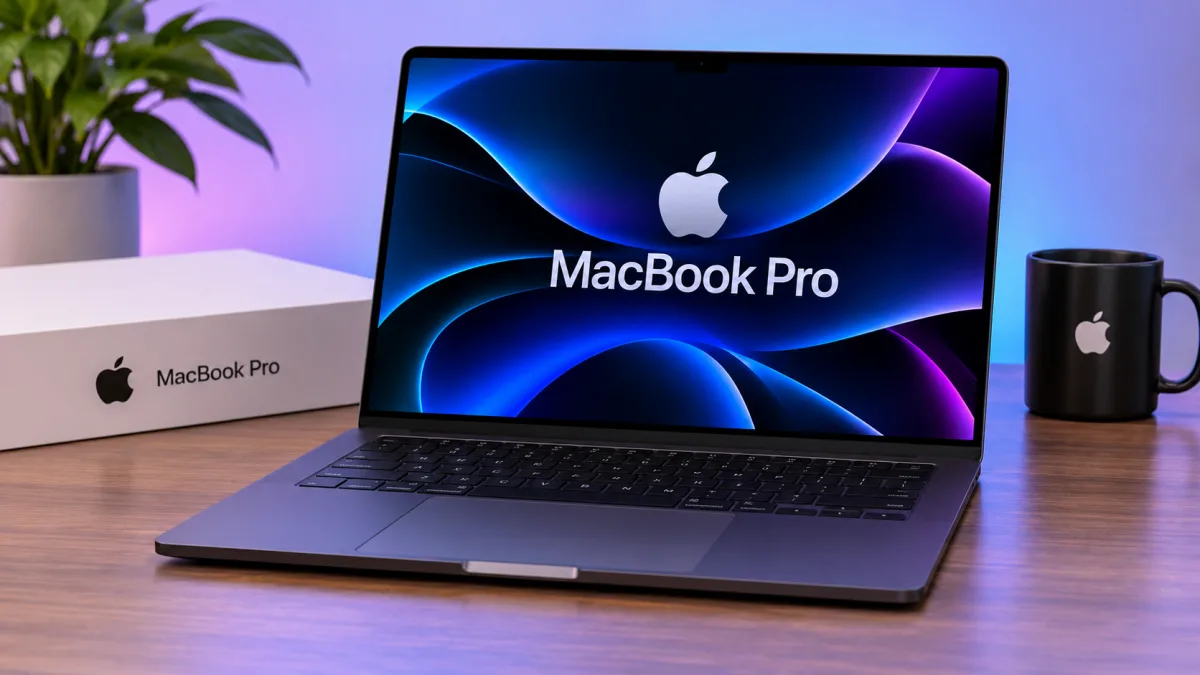
Apple's latest MacBook Pro arrives at a time when buying a new computer has become more complicated than ever. With laptop prices continuing to rise and artificial intelligence rapidly changing the technology landscape, consumers are increasingly questioning whether the computers they purchase today will remain relevant in the coming years.
The new MacBook Pro sits right at the center of these discussions. It combines Apple's established hardware and software experience with early steps toward a new generation of AI powered computing. However, while the device delivers impressive build quality and premium features, its high price raises important questions about long term value.
Apple MacBook Pro: Premium Design Meets a Changing Technology Landscape
The MacBook Pro represents several important transitions for Apple. It arrives during a period of leadership changes within the company, potentially raising questions about the future direction of its products and ecosystem.
At the same time, it remains a mainstream premium laptop that can become extremely expensive when configured with sufficient memory and storage. For professionals who want a machine capable of handling demanding workloads for several years, these upgrades may be necessary, but they can push the final price beyond the reach of many individual consumers.
Another interesting development is Apple's growing interest in artificial intelligence. Although the MacBook Pro remains built around traditional computing workflows, the increasing importance of local AI processing suggests that future versions could look and perform very differently.
Perhaps one of the most surprising changes is the introduction of touchscreen functionality. This represents a notable departure from Apple's traditional approach to MacBooks, signaling a willingness to explore features that were previously absent from its laptop lineup.
MacBook Pro Specifications and Connectivity
Despite the broader changes happening across the technology industry, several important aspects of the new MacBook Pro remain familiar.
Apple continues to advertise up to 24 hours of battery life. However, achieving this figure will likely require relatively light usage and conservative power settings. Users running demanding applications, editing videos, or performing intensive workloads should expect battery life to vary depending on their activities.
Connectivity options also remain largely unchanged, offering a practical selection of ports for professional users.
The available connections include:
Three Thunderbolt ports for high speed data transfer and external devices.
One HDMI port for connecting external displays.
One SDXC card slot for photographers and content creators.
One MagSafe charging connection.
The laptop also features Apple's N1 wireless connectivity chip, bringing support for WiFi 7 and Bluetooth 6.
These specifications help maintain the MacBook Pro's position as a versatile professional laptop, particularly for users who rely on multiple accessories and external displays.
M5 Pro and M5 Max: Powerful Chips With Familiar Performance
The latest MacBook Pro continues to offer Apple's M5 Pro and M5 Max processors, delivering the performance expected from the company's high end laptop lineup.
Benchmark testing indicates that performance remains broadly similar to the previous generation when running comparable synthetic tests. This means that users should not necessarily expect a dramatic performance improvement over the immediate predecessor.
Nevertheless, the M5 Pro and M5 Max remain extremely capable processors. They provide more than enough computing power for everyday productivity, professional applications, creative workflows, and many demanding 3D workloads.
For video editors, developers, designers, and other professionals, these processors offer substantial performance for current applications.
However, artificial intelligence processing is an area where future improvements could become particularly important.
Artificial Intelligence Could Be the Biggest Challenge for Future Proofing
Although the M5 Pro and M5 Max are powerful enough for today's AI applications, the artificial intelligence industry is evolving at an extraordinary pace.
Local AI processing, also known as on device AI, is becoming increasingly important because it allows computers to run certain AI models directly on their hardware instead of relying entirely on cloud based services.
This approach can offer several advantages, including improved privacy, reduced dependence on internet connectivity, and potentially faster responses.
However, running increasingly sophisticated AI models requires significant memory bandwidth and powerful dedicated processing hardware.
This is where the current MacBook Pro generation may eventually show its limitations compared with future Apple Silicon processors.
The M5 Pro and M5 Max are not inadequate for AI workloads. Rather, the concern is that upcoming generations could introduce substantial improvements that make today's hardware less attractive for users who prioritize advanced local AI capabilities.
Apple's M7 Chip Could Bring Major AI Improvements in 2027
According to Bloomberg reporting by Mark Gurman, Apple is reportedly planning significant changes to its future high performance processors, with the M7 generation expected to focus heavily on on device artificial intelligence.
The reported strategy suggests that Apple could prioritize memory bandwidth and AI processing capabilities rather than focusing exclusively on traditional CPU and GPU performance improvements.
Memory bandwidth is particularly important for AI because large models require fast access to substantial amounts of data. Improving this area could allow future MacBook Pro devices to run more advanced AI workloads efficiently.
If these developments materialize, the M7 generation could represent a meaningful shift in Apple's processor strategy.
For consumers considering an expensive MacBook Pro today, this possibility introduces another important purchasing consideration. Those who primarily need a powerful laptop for professional software may find the current generation more than sufficient, while users planning to invest heavily in local AI development might benefit from waiting for future hardware.
The A20 Pro Provides Clues About Apple's AI Strategy
Even without reports about Apple's future M7 processors, there are already indications that the company is placing greater emphasis on AI hardware.
The A20 Pro chip, introduced in Apple's latest iPhone lineup, provides an interesting example of this direction.
The processor brings improvements to its Neural Engine alongside increased memory bandwidth. These changes are particularly relevant because they help support more demanding AI processing directly on mobile devices.
The A20 Pro has also demonstrated improvements in certain 3D graphics workloads, suggesting that Apple's hardware development is not limited to artificial intelligence alone.
These developments could provide an indication of what Apple intends to achieve with its future Mac processors.
As AI becomes a more important part of everyday computing, improvements to dedicated AI hardware, memory architecture, and graphics performance are likely to play an increasingly important role in Apple's product strategy.
Is the New MacBook Pro Worth Buying?
The latest MacBook Pro remains an impressive laptop, offering excellent hardware quality, a high quality display, powerful processors, extensive connectivity, and strong performance across professional applications.
However, its value depends heavily on what buyers expect from their next computer.
For users who need a reliable professional machine for video editing, software development, graphic design, productivity, and 3D applications, the M5 Pro and M5 Max provide more than enough performance for most foreseeable workloads.
On the other hand, buyers who want to invest in a laptop specifically for advanced local AI processing may want to consider the potential improvements coming with future Apple Silicon generations.
The biggest challenge is the price. Configuring the MacBook Pro with enough RAM and storage for long term professional use can make it significantly more expensive than many competing laptops.
Ultimately, Apple's latest MacBook Pro is a powerful and well equipped machine, but it also highlights an important question facing the entire computer industry: How much should consumers invest in today's hardware when the next major computing revolution may already be approaching?
For now, the M5 Pro and M5 Max remain excellent choices for demanding traditional computing workloads. But if Apple's reported plans for the M7 generation become reality, the next major MacBook Pro upgrade could bring some of the most important AI related improvements the company has introduced in years.