
Google's parent company, Alphabet, has reported its financial results for the third quarter of 2026, revealing a significant increase in revenue. However, despite delivering billions in earnings and achieving impressive year over year growth, the company's stock experienced one of the sharpest declines in its history following the earnings announcement.
The unexpected market reaction reflects growing investor concerns about Google's financial performance, particularly the profitability of its artificial intelligence investments, the changing economics of online search, and the company's plans to increase AI spending in the coming year.
Alphabet Reports $128 Billion in Revenue but Investors Remain Concerned
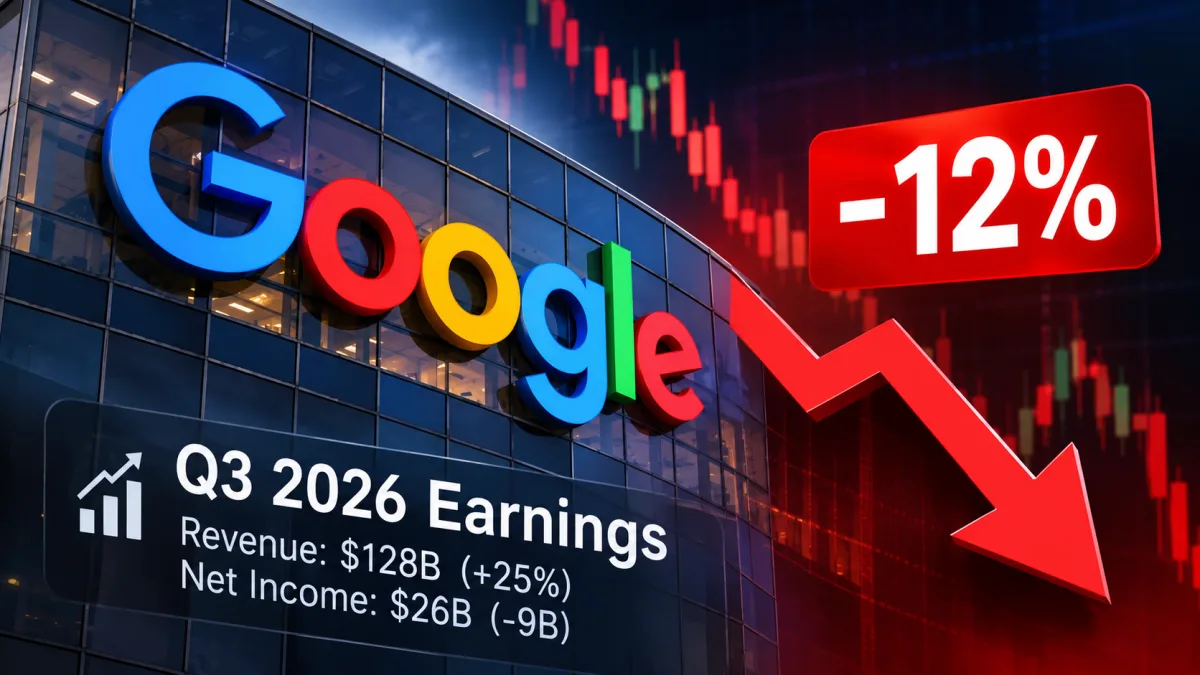
During the third quarter of 2026, covering July through September, Alphabet generated nearly $128 billion in total revenue and reported more than $26 billion in net income.
Although these figures demonstrate the company's continued financial strength, investors were disappointed by several aspects of the results.
Alphabet's revenue increased by approximately 25 percent compared with the same period last year. However, net income declined by nearly $9 billion, raising questions about the company's profitability and growing operational expenses.
The stock market reaction was particularly negative. Alphabet shares fell nearly 12 percent following the announcement, after experiencing an intraday decline of approximately 13 percent.
Another major disappointment came from earnings per share (EPS). Alphabet reported earnings of $2.12 per share, significantly below analysts' expectations of $3.02.
Despite the weaker than expected earnings, Google Cloud delivered a positive performance, generating more than $30 billion in revenue. This figure exceeded analysts' estimates by approximately $1 billion, highlighting continued demand for Google's cloud computing services.
Google's AI Strategy Raises Questions About Search Profitability
One of the biggest concerns emerging from Alphabet's latest earnings report is the financial impact of its growing artificial intelligence investments.
Over the past few years, Google has accelerated its AI development strategy, integrating generative AI technologies into several major products, including Gmail, Android, and Google Search.
The company is also transforming its traditional search experience by introducing AI powered features supported by its Gemini models.
While these developments demonstrate Google's commitment to remaining competitive in the rapidly evolving AI industry, they are also creating questions about the long term profitability of its core search business.
A particularly important issue is the difference in revenue generated by traditional organic search and AI powered search experiences. Google's latest financial disclosures indicate that AI search is not currently generating the same level of revenue as conventional search.
This creates a challenge for the company as it attempts to introduce new AI experiences without negatively affecting the advertising business that has historically generated a substantial portion of its revenue.
Google Search Growth Slows Despite Increasing Search Activity
During Alphabet's earnings call, Chief Business Officer Philipp Schindler discussed the company's search performance and overall search volume.
According to the reported figures, Google Search volume increased by 12 percent in the third quarter of 2026 compared with the same period in 2025.
Although search activity continued to grow, the latest figure represents a noticeable slowdown compared with previous quarters.
In the second quarter of 2026, search volume increased by 17 percent year over year, while the first quarter recorded growth of approximately 19 percent.
The decline in growth momentum is attracting attention from investors because Google Search remains one of Alphabet's most important sources of revenue.
More concerning is the fact that search revenue remained flat during the third quarter, despite the increase in search volume.
This suggests that generating more searches does not necessarily translate into higher advertising revenue, particularly as Google continues experimenting with AI powered search experiences.
Rising AI Investment Could Put Additional Pressure on Alphabet's Profits
Another factor contributing to investor concerns is Alphabet's intention to increase its artificial intelligence spending next year.
Developing advanced AI models, expanding data center infrastructure, purchasing specialized computing hardware, and maintaining the resources required to operate AI services all involve substantial costs.
Although these investments could strengthen Google's competitive position against other major technology companies, they may also put additional pressure on profit margins.
Investors are increasingly looking for evidence that Google's AI strategy can generate sustainable revenue and deliver attractive financial returns.
The challenge for Alphabet is to balance its investments in artificial intelligence with the profitability of its existing businesses, particularly Google Search and Google Cloud.
What Google's Q3 2026 Results Mean for Its Future
Alphabet's third quarter financial results highlight a growing gap between revenue growth and investor expectations.
The company continues to generate enormous revenue, while Google Cloud remains a major growth opportunity. However, declining net income, weaker than expected earnings per share, slower search growth, and questions surrounding AI search monetization have created uncertainty about its financial outlook.
Google's ability to turn artificial intelligence into a profitable business will likely play a major role in determining its future stock performance.
For now, investors appear to be demanding more than impressive revenue growth. They want clear evidence that Google's massive AI investments can produce sustainable profits without weakening the company's highly profitable search advertising business.
The key question for Alphabet is no longer how quickly it can develop AI technology, but how effectively it can turn that technology into long term revenue and profitability.