
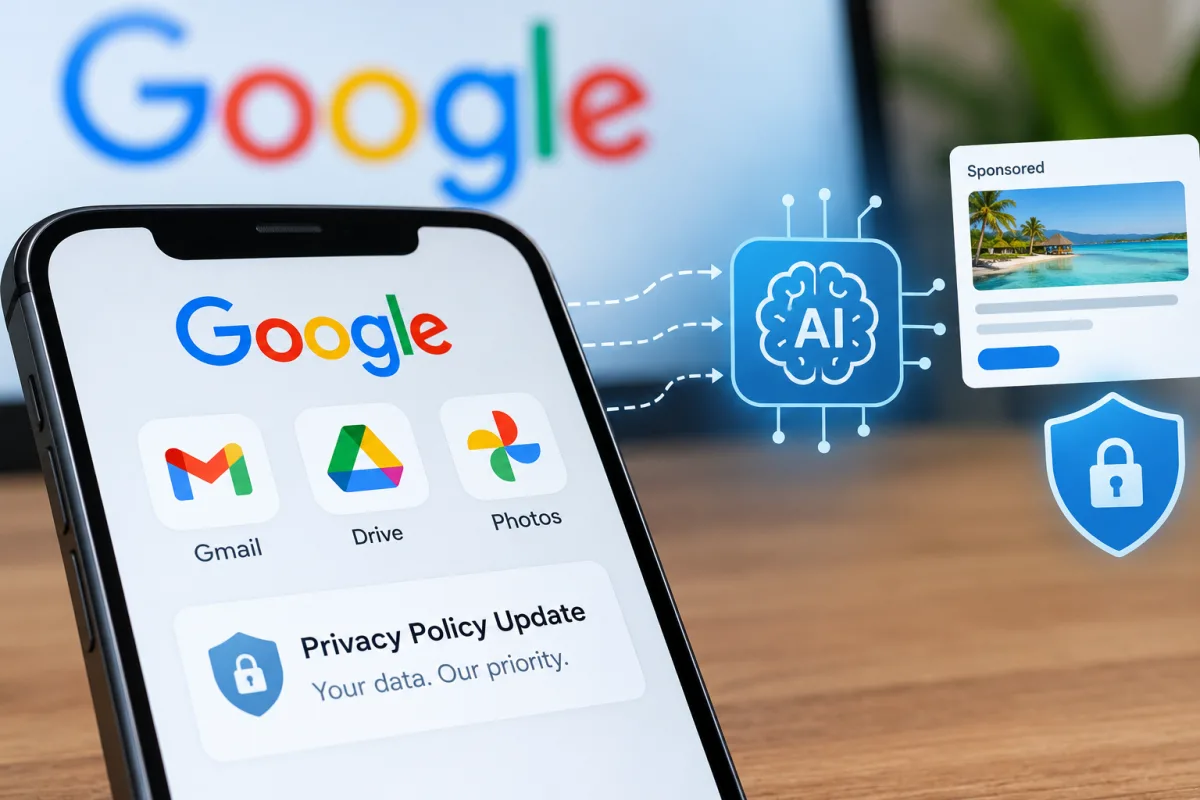
Google is facing renewed privacy concerns following an update to its privacy policy that could affect how personal information shared across its services influences personalized advertising. The change has raised questions about the separation between users' private data and Google's advertising systems, particularly when information from Gmail, Google Drive, and Google Photos is connected to artificial intelligence tools.
For years, Google has maintained that it does not use sensitive information from certain services to personalize advertisements directly. However, a recent revision to its privacy policy appears to introduce more flexibility in how information shared between its products may be used.
Google Updates Its Privacy Policy
On October 16, Google updated its privacy policy in a change first reported by Android Authority. The revision affects the section explaining how the company uses personal information for ad personalization.
Previously, Google's policy explicitly stated that personalized advertisements were not based on content from Google Drive, Gmail, or Google Photos. This wording provided users with a clear distinction between their private content and the information used to tailor advertisements.
The updated language has raised concerns because it appears to leave room for information shared with other Google services to play a role in advertising personalization.
Although the revision does not explicitly state that Google will directly analyze private emails or personal photo libraries to deliver advertisements, it has prompted questions about what happens when users voluntarily connect their personal data to other Google products.
Personal Intelligence Raises New Privacy Questions
One of the key developments behind these concerns is Google's Personal Intelligence feature, introduced in early 2026.
Personal Intelligence allows users to connect information from multiple Google applications to supported AI products. The goal is to provide more personalized and contextually relevant responses by allowing artificial intelligence to draw on information users have already shared across their connected services.
For example, connecting personal information to Google's AI tools may help the system provide answers that better reflect a user's preferences, activities, and existing information.
However, this convenience also introduces potential privacy concerns. When information from applications such as Gmail and Google Photos becomes available to connected AI services, users may have questions about how that information is handled and whether it could indirectly influence other Google products.
The updated privacy policy has intensified these concerns, particularly regarding the relationship between personal information shared with AI services and the advertisements users may encounter elsewhere.
Could Gmail and Google Photos Data Influence Google Ads?
The central concern is whether information shared through Personal Intelligence could indirectly affect the advertisements displayed across Google's services.
Personal Intelligence connects user data to the Gemini app and certain other AI powered experiences, including AI Mode in Google Search. While the Gemini app does not currently display advertisements, Google's AI search experiences may include sponsored content.
This creates an important distinction between using personal information directly to select advertisements and using information shared with AI services to provide broader context that could influence advertising relevance.
The policy change appears to acknowledge the possibility that information shared with AI powered search tools may be relevant to the broader advertising experience. However, the updated wording alone does not establish that Google directly uses the contents of Gmail inboxes or Google Photos libraries to target advertisements.
For users, the key question is how information moves between connected applications, AI features, search tools, and advertising systems.
Google Says Connecting Apps Is Optional
Google has responded to the concerns by emphasizing that connecting applications to its AI features is entirely optional.
The company maintains that advertisements will continue to be influenced by factors such as users' search queries, the context of responses, and their interests. Google also states that advertisements will not be based directly on the contents of Gmail inboxes or Google Photos libraries.
In addition, Google says sensitive personal information will not be used to tailor advertisements.
These assurances suggest that the company distinguishes between the information users voluntarily share with AI products and the personal content it uses directly for advertising purposes.
Nevertheless, the revised policy has highlighted the importance of understanding how data sharing works across interconnected digital services. Even when a feature is optional, users may want greater clarity about what information is shared, how it is processed, and whether it can affect their experience across other products.
What Google Users Should Know
The policy update serves as a reminder that privacy settings and data sharing permissions deserve careful attention, especially as artificial intelligence becomes more closely integrated with everyday applications.
Users who prefer to limit the amount of personal information shared with Google's AI services should review the available Personal Intelligence and connected application settings before enabling these features.
It is also worth reviewing Google's privacy controls and understanding which applications are connected to AI tools. Users should pay particular attention to the permissions granted to services that can access personal emails, photos, documents, or other sensitive information.
The availability of an opt in feature gives users a choice, but making an informed decision requires understanding the potential implications of connecting different sources of personal data.
Final Thoughts
Google's updated privacy policy has raised new questions about the relationship between personal data, artificial intelligence, and online advertising. Although the company maintains that advertisements will not be based directly on Gmail inboxes or Google Photos libraries, the revised wording has prompted concerns about how information shared across connected services could influence personalized advertising.
As AI powered search and personal assistants become more integrated into digital platforms, transparency about data usage will remain essential. For Google users, reviewing privacy settings and understanding how connected applications share information can help them make more informed decisions about their personal data.
Ultimately, the issue extends beyond advertising alone. It highlights a broader challenge for technology companies, finding ways to deliver personalized AI experiences while maintaining clear boundaries around user privacy.