
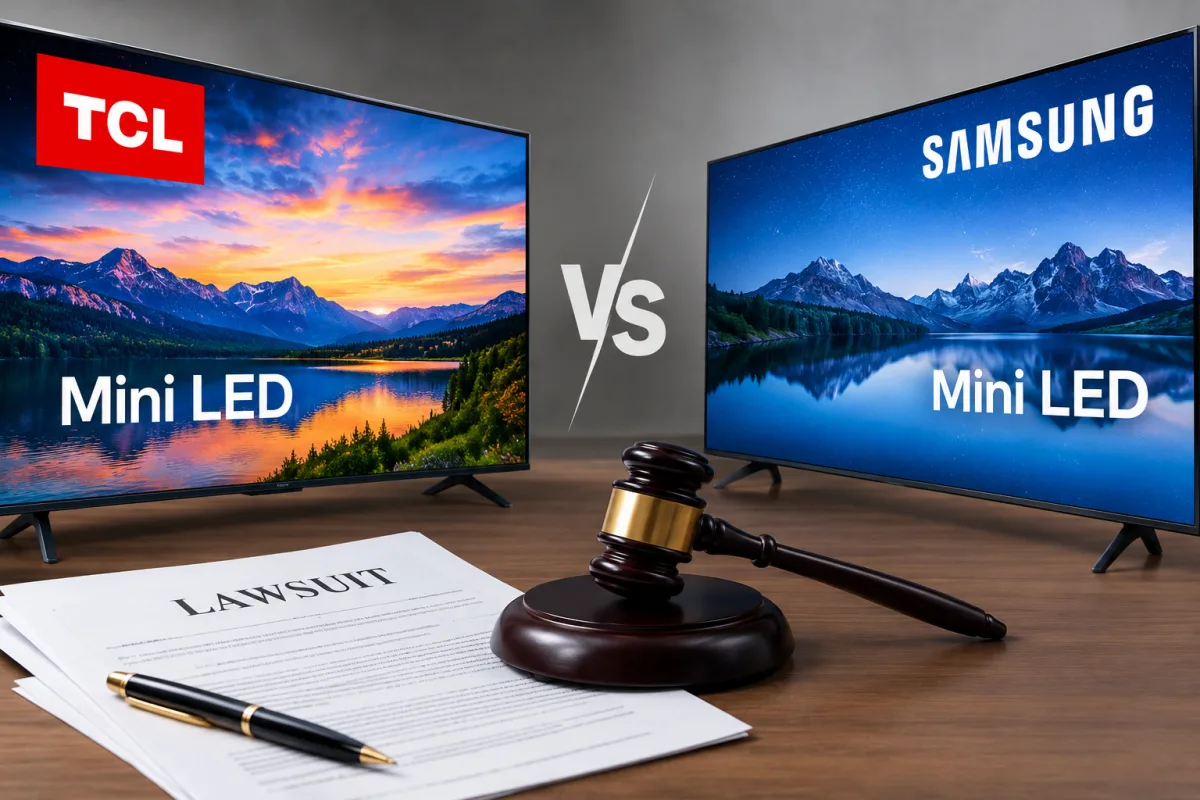
The question may sound simple, but determining what actually qualifies as a Mini LED television has become the center of a legal dispute between two major TV manufacturers.
TCL has filed a lawsuit against Samsung, accusing the company of falsely advertising several budget LCD LED televisions as Mini LED models. The case raises questions not only about Samsung’s M Series TVs, but also about how the television industry defines and markets Mini LED technology.
For consumers, the dispute highlights a broader issue. There is currently no universally agreed standard that clearly defines what a television must contain to be marketed as Mini LED. As a result, manufacturers have significant flexibility in how they describe and promote the technology.
TCL Accuses Samsung of Misleading Mini LED Marketing
According to a lawsuit filed in the US District Court for the Central District of California in late August, TCL alleges that Samsung used misleading marketing to compete with TCL’s QM Series Mini LED televisions.
The lawsuit specifically targets Samsung’s M70H, M80H, and M90H models. TCL claims that these televisions are essentially existing entry level LED products from Samsung’s Crystal UHD range that were relabeled and marketed as Mini LED televisions.
TCL’s complaint goes further, arguing that Samsung’s M Series models lack several of the technological features commonly associated with Mini LED displays, including full array local dimming.
The allegations remain claims made in an ongoing lawsuit and have not been established as facts by a court.
Samsung did not provide a detailed response to questions concerning the specific allegations in TCL’s lawsuit. Instead, a company spokesperson said that Samsung intends to vigorously defend itself against the case.
What Is Mini LED Technology?
Mini LED is a display technology that uses a much larger number of smaller LED backlights compared with conventional LED LCD televisions.
The smaller size of these LEDs allows manufacturers to create more precise backlighting systems. One of the main advantages is the ability to divide the screen into more local dimming zones, which can improve contrast and help produce darker areas of an image while maintaining bright highlights.
This technology is different from OLED, where individual pixels can produce their own light. Mini LED televisions remain LCD displays, but they use more advanced LED backlighting to improve picture quality.
The exact implementation, however, can vary considerably between manufacturers and television models.
Why Full Array Local Dimming Matters
Full array local dimming is an important part of the discussion surrounding Mini LED televisions.
In a full array system, LEDs are positioned behind the LCD panel rather than only along the edges of the screen. The television can then independently adjust different areas of the backlight depending on what is being displayed.
For example, if a scene contains a bright moon against a dark night sky, local dimming can reduce the brightness of the areas surrounding the moon while keeping the moon itself bright.
Mini LED technology can significantly increase the number of these controllable areas because it uses much smaller LEDs. This can potentially improve contrast, reduce blooming, and produce better HDR performance.
However, the presence or absence of particular features can vary between different implementations, which contributes to the confusion surrounding Mini LED marketing.
Samsung M Series Prices Raise More Questions
Samsung’s M Series televisions are positioned at relatively accessible price points compared with many premium Mini LED models.
The range includes models starting at around $300 for a 43 inch television and extending to approximately $2,300 for a 100 inch model.
TCL argues that these products should not be marketed as Mini LED televisions if they do not provide the technological characteristics consumers generally associate with the term.
The dispute therefore goes beyond the specifications of individual televisions. It raises a broader question about whether consumers can rely on the Mini LED label when comparing products from different manufacturers.