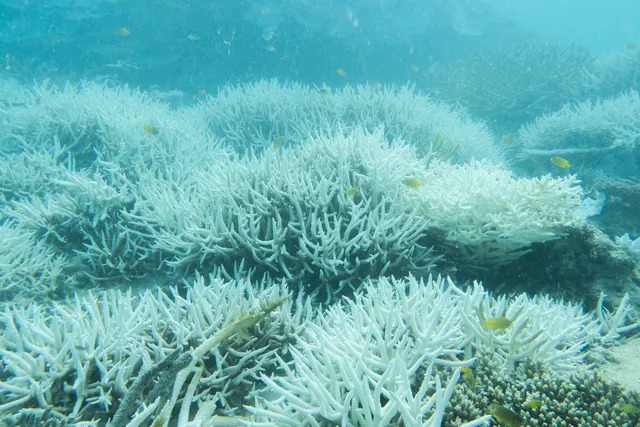
The Great Barrier Reef and surrounding waters have reached hotter temperatures over the past decade than they have in at least 400 years because of climate change, according to new research published in the journal Nature.
It’s a stark warning. The survival of the Great Barrier Reef is essentially now in human hands. Corals around the world face near extinction if temperatures continue to rise with the world running primarily on fossil fuels.
“The reef is in danger.
“The reef is in danger, and if we don’t divert from our current course, our generation will likely witness the demise of one of Earth’s great natural wonders, the Great Barrier Reef,” Benjamin Henley, lead author of the research and a lecturer at the University of Melbourne and an honorary fellow at the University of Wollongong, said in a Tuesday press briefing.
Corals are animals that secrete calcium carbonate skeletons that form reefs. The skeletons of corals that can grow for centuries allowed Henley and his coauthors to look into the past. As they grow, they form bands that scientists can study like tree rings. They contain chemical signatures that show heat stress in certain years. The ratio of strontium to calcium and the oxygen isotope ratio in particular relate to the temperature of the water at the time the corals were still growing.
There isn’t consistent data on sea surface temperatures from direct measurements prior to 1900. But the researchers were able to combine what data was available from direct measurements with data from skeleton core samples to build a statistical model that they then used to reconstruct temperatures going back to the 1600s. They focused on temperatures between January and March when waters surrounding Australia’s Great Barrier Reef tend to be the hottest.
That’s how they discovered that those periods in 2024, 2020, and 2017 reached the highest temperatures in four centuries. 2024 has been the most remarkable, roughly 1.73 degrees Celsius above the reconstructed average between 1618 and 1899.
Under heat stress, corals will expel the algae that give them nutrients and color. It’s a phenomenon called bleaching, and the corals can die from it over time. If temperatures linger roughly 1 degree Celsius above what’s “normal” for the summer for more than two months, they can trigger mass coral bleaching events, according to a related article on the research published in Nature.
The past year has marked the world’s fourth global coral bleaching event on record — wreaking havoc on reefs around the world and even triggering a race to temporarily relocate coral nurseries to land to try to save them. Global bleaching events also took place in 1998, 2010, and between 2014 and 2017.
Coral skeleton cores the researchers assessed showed hardly any stress bands before 1980, a sign that mass bleaching events were far less likely before then. Using climate models to look at potential outcomes with and without human influence, the authors of the paper conclude that “human influence on the climate system is responsible for the rapid warming in recent decades.”
The Great Barrier Reef faces its biggest threat in centuries
The Great Barrier Reef and surrounding waters have reached hotter temperatures over the past decade than they have in at least 400 years because of climate change, according to new research published in the journal Nature.