
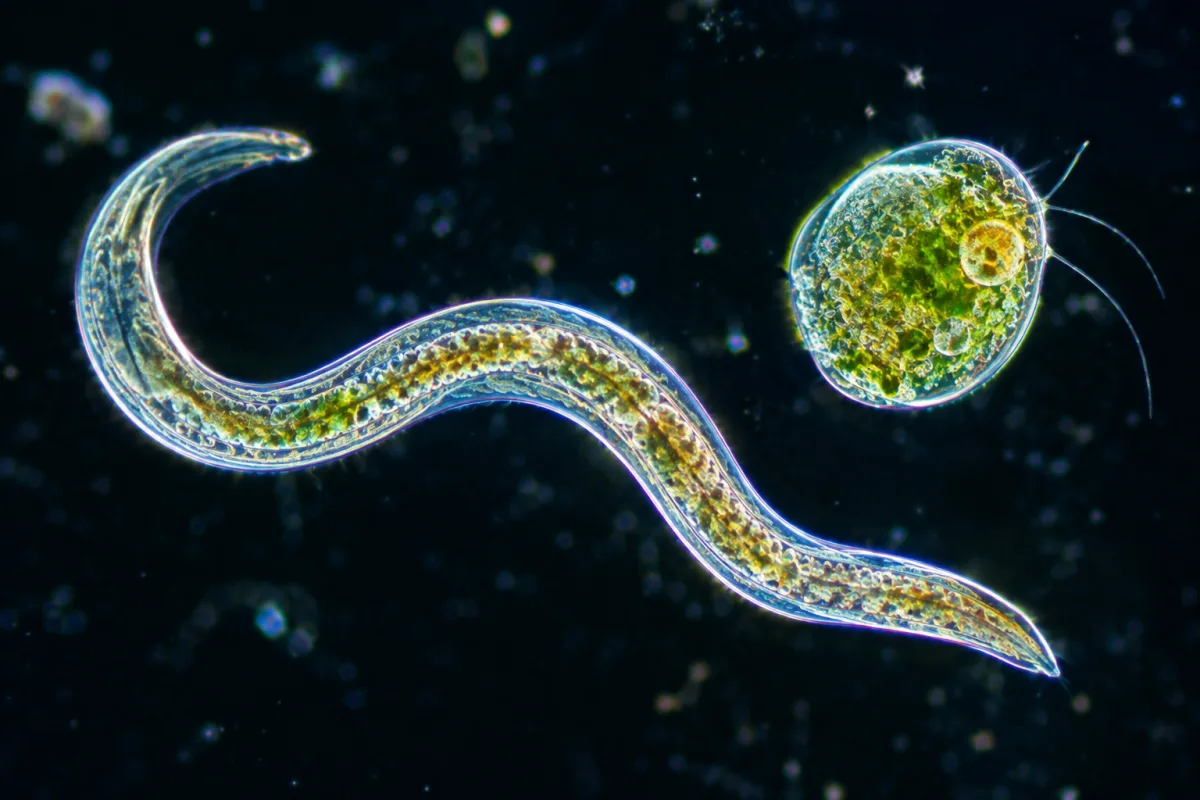
Nikon has announced a change to the results of its prestigious Small World in Motion microscopy video competition after an investigation found that the original winning entry did not comply with the contest’s rules on generative artificial intelligence. The new winner is Nguyen Nam Nhat of Vietnam, whose video captures the microscopic interaction between a tiny roundworm and a single celled organism.
The decision follows allegations surrounding a video submitted by Ning Xu of Tsinghua University in China. Xu’s original winning entry showed tiny cilia beating inside the airways of a child with a rare respiratory disorder. Although the video initially received the competition’s top honor, questions about the possible use of artificial intelligence prompted Nikon to review the submission and its supporting materials.
Why Nikon Disqualified the Original Winning Video
According to a report by the BBC, several researchers raised concerns about unusual visual features in Xu’s video. They pointed to apparent structural abnormalities and cellular features that seemed to appear and disappear in ways inconsistent with normal biological processes. Other observers reportedly identified what appeared to be AI related watermarks embedded in the source files.
Xu acknowledged using artificial intelligence to help distinguish and visualize features in reconstructed grayscale images. However, he denied using AI to generate the experimental video itself, the cilia, or their movement.
After reviewing the video, examining the supporting materials, and consulting members of its judging panel, Nikon concluded that the entry did not meet the competition’s requirements concerning generative AI.
In its official statement, Nikon explained that the decision was based exclusively on the eligibility of the submitted video under the competition rules. The company emphasized that the disqualification should not be interpreted as a judgment of Xu’s professional reputation, scientific contributions, or intentions.
Nikon also updated the rankings published on its website to reflect the decision.
Nguyen Nam Nhat of Vietnam Takes First Place
Following the disqualification, Nguyen Nam Nhat of Vietnam became the new winner of the Nikon Small World in Motion competition. His video features a tiny roundworm alongside a single celled organism, offering viewers a closer look at the remarkable details of microscopic life.
The updated results highlight the competition’s mission to showcase the beauty, complexity, and scientific importance of organisms and biological processes that are normally invisible to the naked eye.
The revised rankings also moved the other finalists up one position, recognizing their work under the competition’s updated results.
Updated Nikon Small World in Motion Winners
The revised competition rankings include several striking examples of scientific microscopy and biological imaging.
Second place went to Benedikt Pleyer of Bavaria, Germany, for a video showing jellyfish larvae suspended in water droplets.
Andrew Moore of the Howard Hughes Medical Institute in the United States earned third place with a video capturing synchronized cell division in neighboring cells. The footage demonstrates the intricate coordination involved in biological processes at the microscopic level.
Patrick Hickey of Hypha Research Ltd. in Edinburgh, Scotland, secured fourth place with a video exploring the dynamics of mitochondria and chloroplasts in the leaf cells of Turtle Vine.
Fifth place went to Igor Adameyko for a colorful video featuring a small sea slug, identified as Cyerce kikutarobabai, moving through its environment.
Together, the winning entries demonstrate how advanced microscopy can reveal the movement, structures, and biological processes that conventional photography cannot capture.
What Is the Nikon Small World in Motion Competition?
Established in 2011, the Nikon Small World in Motion competition grew out of the Nikon Small World Photomicrography Competition, which dates back to 1974.
Both competitions celebrate the artistic and scientific value of microscopy. Their shared goal is to showcase the beauty and complexity of objects and organisms viewed through a light microscope.
While the original Nikon Small World competition focuses on still photographs, Small World in Motion highlights video microscopy, including moving images and time lapse footage. Advances in imaging technology have made it possible for researchers and photographers to document living cells, microorganisms, and biological processes in increasingly detailed ways.
The competition provides a platform for scientists, researchers, and imaging specialists to share discoveries and reveal the hidden world of microscopic life to a wider audience.
Artificial Intelligence Creates New Challenges for Scientific Imaging
Nikon’s decision reflects a growing challenge across scientific research and visual media as artificial intelligence tools become more sophisticated and accessible.
AI can assist researchers in analyzing complex images, identifying structures, improving visualization, and interpreting large amounts of scientific data. However, concerns arise when AI generated or modified content affects the authenticity of visual evidence, particularly in competitions designed to recognize genuine scientific imaging.
The distinction between using AI as an analytical tool and using generative AI to create or alter visual content is becoming increasingly important. Scientific images and videos often serve as evidence of biological processes, making transparency about image processing and the role of AI essential.
Nikon acknowledged that rapid advances in imaging technology and artificial intelligence are creating new challenges for organizations across multiple fields. The company said the incident demonstrated the need to revisit the rules and evaluation procedures used in future editions of both the Nikon Small World and Small World in Motion competitions.
Nikon Reaffirms Its Commitment to Scientific Imaging Standards
Despite the controversy, Nikon emphasized its commitment to maintaining the integrity of the images and videos featured in its winning galleries.
The company stated that both competitions aim to celebrate excellence in scientific and artistic imaging. It also stressed the importance of ensuring that every selected entry meets the standards established for the competition.
The case involving Xu’s video illustrates how scientific competitions may need to adapt as new technologies change the way images are produced, processed, and presented.
As microscopy and artificial intelligence continue to advance, clear guidelines and transparent evaluation procedures will play an increasingly important role in preserving public trust in scientific visual content.
For Nikon, the updated results reaffirm the importance of balancing technological innovation with the authenticity and integrity that have defined its microscopy competitions for decades.