
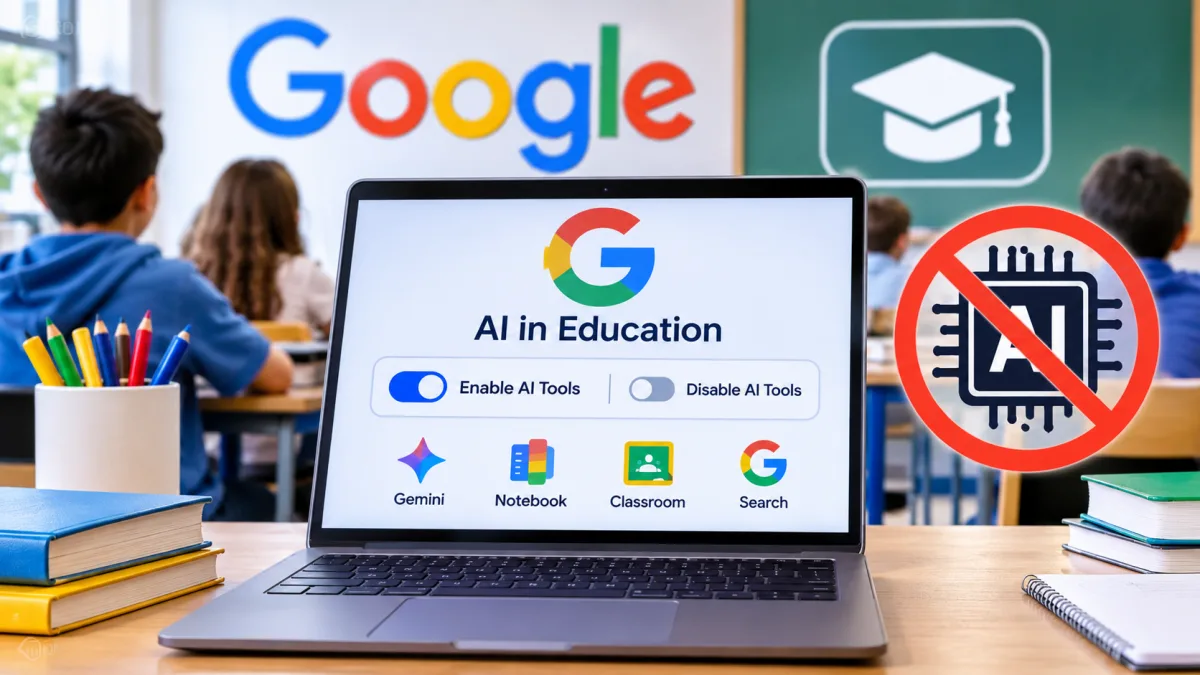
Google is introducing a new approach to artificial intelligence in education, giving schools greater control over whether students can use AI powered tools in the classroom. However, the decision comes with an unexpected consequence: schools that choose to disable Google's AI features may also lose access to Google Search.
Although Google continues to explore opportunities beyond Chromebooks, its education products remain widely used in schools around the world. This gives the company a significant influence over how students and teachers interact with digital learning tools. Its latest policy could therefore have a major impact on the future of AI in education.
Google Makes AI Tools Optional in Schools
Following discussions with educators, researchers, and lawmakers, Google has announced that AI features in its education products will be disabled by default for schools.
Under the new policy, school administrators will have the option to manually activate these tools when the changes begin rolling out in the coming months. This approach is intended to give educational institutions more control over how artificial intelligence is introduced into classrooms.
At first glance, the decision appears to offer schools greater flexibility. However, the situation becomes more complicated when examining which services Google considers part of its AI ecosystem.
Disabling AI Could Also Disable Google Search
Google's new policy covers several major products, including Gemini, Gemini Notebook, Gemini in Classroom, and Google Search.
The main concern is that schools will not be able to independently enable or disable each service. Instead, they will face an all or nothing decision, allowing access to Google's AI powered ecosystem or blocking it entirely.
This creates a difficult situation for schools that want to prevent students from using generative AI while continuing to provide access to traditional online search tools.
Google's position reflects its broader strategy of transforming Search into an AI powered experience. The company has increasingly integrated AI Overviews into search results while promoting AI Mode, its conversational search experience.
In a statement to The New York Times, Google Education Vice President Chris Phillips explained that traditional search and artificial intelligence are now closely connected.
He emphasized that schools choosing not to enable AI features will also lose access to Google Search. Instead, students will receive a message informing them that the service is unavailable because of their school's settings.
Google Introduces Guided Learning for Students
Rather than offering a completely AI free version of Google Search for schools, Google is providing different AI experiences for educational users.
When administrators enable AI features for student accounts, they will be able to choose between the standard Gemini experience and a newer option called Guided Learning.
Guided Learning is designed to support students through personalized tutoring and step by step explanations instead of simply providing direct answers.
The feature is intended to make AI more useful as an educational assistant, helping students understand difficult subjects, explore new concepts, and develop problem solving skills.
It is also available through Google Classroom and Google Search, giving students additional ways to access AI powered learning assistance.
However, Google acknowledges that its generative AI products can sometimes produce inaccurate information. This raises questions about how effectively Guided Learning can prevent students from relying on AI to complete assignments without understanding the material.
Why Google's AI Policy Could Change Education
Google's decision could have a significant influence on the adoption of artificial intelligence in schools.
By connecting access to Google Search with its AI ecosystem, the company may encourage educational institutions to enable AI features rather than abandon one of the world's most widely used search engines.
This strategy could introduce students to artificial intelligence at an earlier age and make AI assisted learning a normal part of everyday education.
At the same time, schools and educators may have concerns about accuracy, academic integrity, student independence, and the potential impact of AI on critical thinking skills.
Institutions that prefer to avoid AI powered search may consider alternative services such as DuckDuckGo, which offers options for disabling AI features.
However, switching search engines could require additional adjustments to existing classroom systems and student workflows.
Will Schools Accept Google's All or Nothing Approach?
Google's new education policy highlights an important challenge facing schools as artificial intelligence becomes increasingly integrated into everyday technology.
While giving administrators control over AI access is a positive step, linking that decision to Google Search makes the choice more complicated than simply allowing or blocking a chatbot.
Schools must now consider whether the benefits of Google's AI powered learning tools outweigh concerns about student privacy, academic performance, and the growing role of artificial intelligence in education.
The introduction of Guided Learning may help address some of these concerns by positioning Gemini as a learning assistant rather than an answer generator.
However, the bigger question remains: Should schools be forced to choose between accessing Google Search and avoiding AI tools?
As Google prepares to roll out these changes, educators will have to decide whether its approach represents the future of digital education or creates unnecessary limitations for schools that want more control over classroom technology.