
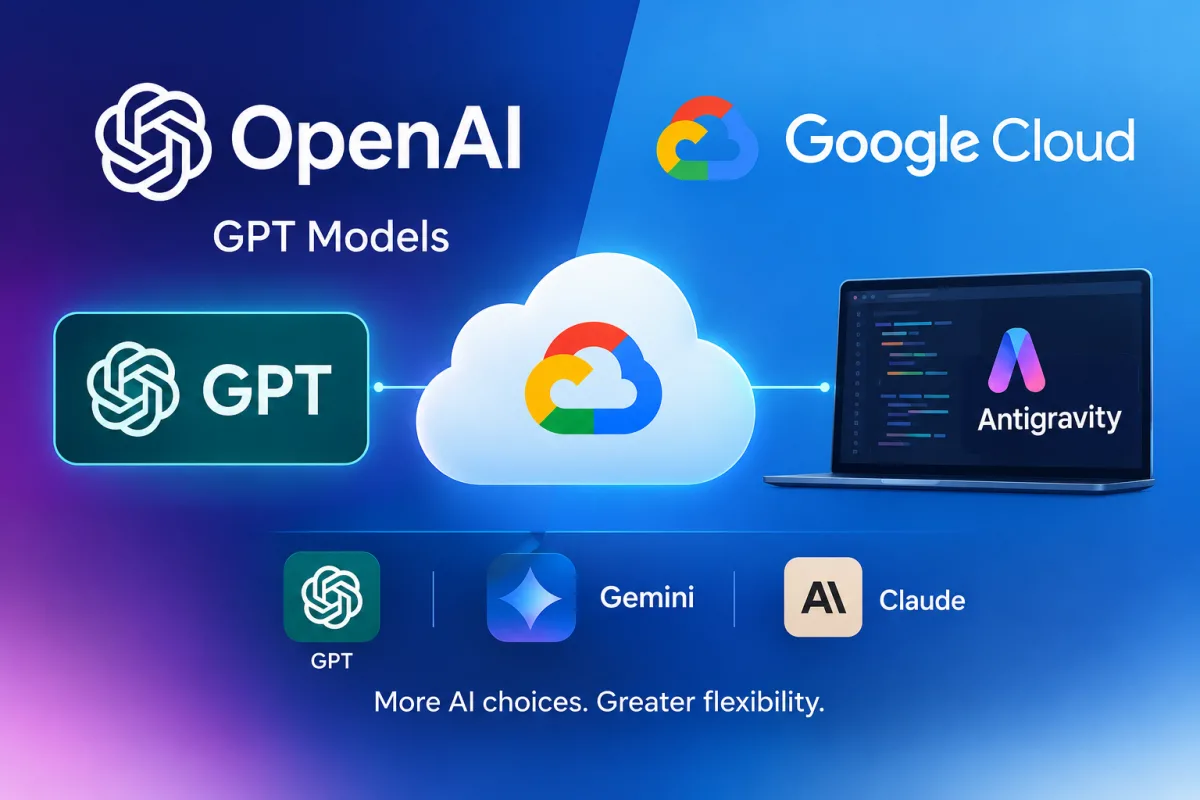
Google is expanding its artificial intelligence ecosystem by bringing OpenAI GPT models to Google Cloud and its Antigravity coding platform. The partnership will give businesses and developers more flexibility when choosing AI models, allowing them to access OpenAI technology alongside Google's Gemini models and Anthropic's Claude AI.
The move represents a significant development in the AI industry, particularly for enterprise customers looking for alternatives to a single AI provider. It could also make advanced AI coding tools more accessible to developers who already use Google's cloud infrastructure.
OpenAI GPT Models to Join Google Cloud Model Garden
Google Cloud customers will soon have access to OpenAI's latest models through Model Garden, Google's platform for discovering and deploying artificial intelligence models. The service already includes more than 200 models, including Google's Gemini, open models such as Mistral, Llama, and Gemma, and Anthropic's Claude.
By adding OpenAI's models, Google is expanding the range of AI technologies available to businesses through a single cloud platform. Google says this makes it the only major cloud provider to offer access to all three leading closed model families from Google, OpenAI, and Anthropic.
This expanded selection could help organizations choose AI models based on their specific requirements, whether they prioritize reasoning capabilities, coding performance, response speed, or operating costs.
GPT Models Bring More Flexibility to Enterprise AI
OpenAI continues to identify Microsoft as its primary cloud partner. However, the agreement with Google Cloud will introduce another deployment option for businesses that want to use OpenAI models within Google's infrastructure.
According to the announcement, the GPT model lineup, including Astra, Sol, and Luna, will become available through Google Cloud. The models are designed to serve different needs, with more advanced models potentially requiring greater computing resources and higher operating costs.
Google Cloud also supports systems that can dynamically route workloads between different large language models. This capability can help businesses balance performance, response latency, and efficiency instead of relying on a single model for every task.
For enterprises already committed to spending on Google Cloud, the integration could simplify the adoption of OpenAI technology. Businesses will be able to access the models through Google Cloud Marketplace, allowing them to incorporate AI services into their existing cloud purchasing and deployment workflows.
OpenAI Models Begin Rolling Out in Private Preview
Google has announced that the OpenAI models are entering a private preview for selected enterprise customers. Organizations interested in early access can submit requests to use the models through APIs.
The integration is also expected to support developers working with OpenAI coding tools, including Codex CLI and Codex Desktop. In this setup, model inference will run on Google's infrastructure, providing another way for developers and organizations to access OpenAI technology.
This approach could be particularly useful for companies that already manage their applications, data, and development environments through Google Cloud. Rather than moving their entire infrastructure to another provider, they may be able to integrate OpenAI models into their existing workflows.
Availability during the initial rollout will be limited to eligible customers, with broader access depending on Google's deployment plans.
Google Antigravity to Support OpenAI GPT Models
The partnership is not limited to enterprise cloud services. Google Antigravity, Google's agent powered coding platform, is also expected to gain support for OpenAI models.
Antigravity already supports Google's Gemini models and Anthropic's Claude. Adding GPT models would give developers another option when building software with AI assistance.
AI powered coding platforms can help developers generate code, understand unfamiliar projects, identify potential errors, and automate parts of the software development process. Access to multiple model families could make these tools more versatile, especially when different models perform better on different tasks.
Google has not specified exactly which OpenAI models will be available inside Antigravity. However, the integration is expected to expand the platform's model selection and give users more flexibility in choosing the AI technology that best fits their development needs.
For developers who prefer OpenAI models but already rely on Google's coding ecosystem, this change could reduce the need to switch between separate tools and services.
Google Gemini Faces More Competition From OpenAI and Claude
Google continues to develop its Gemini AI family and integrate it across its products and cloud services. However, the arrival of OpenAI models on Google Cloud will provide customers with more alternatives within the same ecosystem.
Gemini remains an important part of Google's AI strategy, while Claude and OpenAI models offer additional options for organizations evaluating different approaches to artificial intelligence.
Performance and operating costs will remain important considerations when choosing between these models. More capable models can offer advantages for complex tasks, but they may also consume more tokens and computing resources. As a result, businesses will need to evaluate the tradeoffs between quality, speed, and cost for their specific workloads.
Supporting several model families on one cloud platform could make these comparisons easier and help organizations avoid depending entirely on a single AI provider.
What the OpenAI and Google Cloud Partnership Means for Developers
The integration of OpenAI models into Google Cloud and Antigravity reflects a broader shift toward AI platforms that support multiple model providers.
For enterprise customers, the main benefit is flexibility. Businesses can evaluate different models, choose appropriate solutions for specific applications, and manage AI deployments through infrastructure they already use.
For developers, the addition of GPT models to Antigravity could improve access to alternative AI coding capabilities without requiring them to leave Google's development environment.
The partnership may also increase competition among AI providers, encouraging continued improvements in model performance, developer tools, and deployment options.
Although the long term impact will depend on pricing, availability, and real world performance, the agreement signals that cloud platforms are increasingly competing to offer access to a wide range of AI technologies rather than limiting customers to their own models.
As Google Cloud expands its AI offerings, the addition of OpenAI GPT models could give businesses and developers more control over how they build, deploy, and scale artificial intelligence applications.