
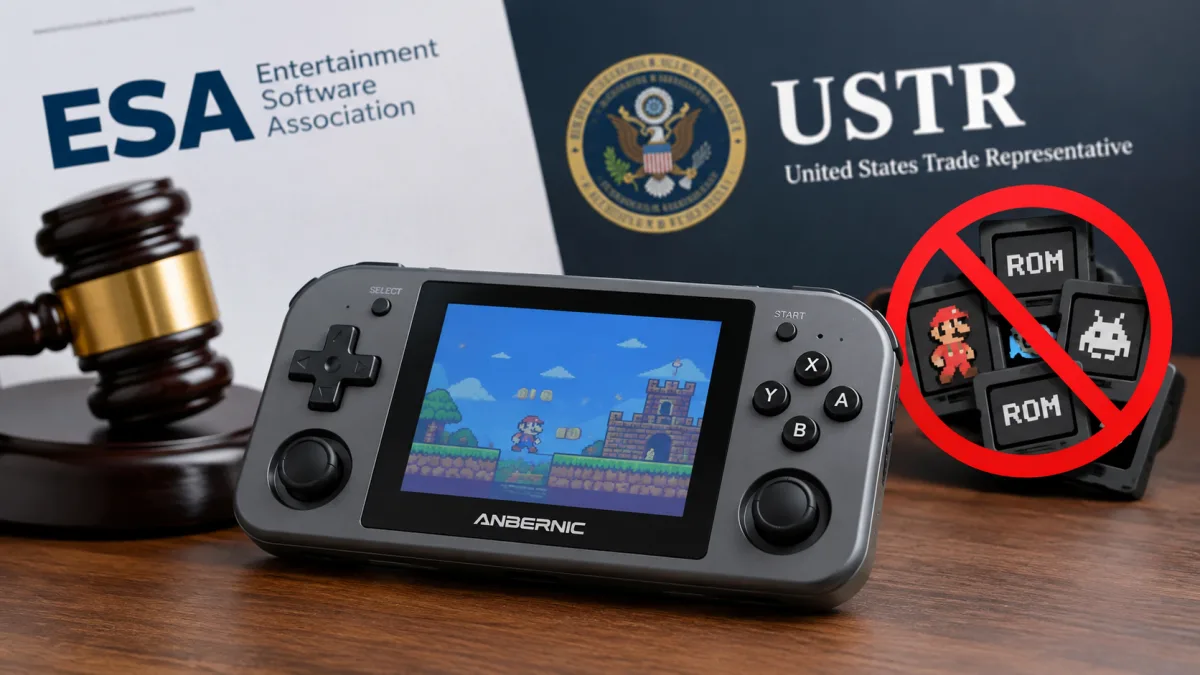
The retro gamiESA Targets Anbernic Over Alleged Video Game Piracy on Retro Gaming Devicesng market is facing renewed scrutiny as the Entertainment Software Association (ESA) calls on the United States Trade Representative (USTR) to add Chinese gaming hardware manufacturer Anbernic to its Notorious Markets List. The request raises concerns about the distribution of unauthorized video game copies through handheld gaming devices designed for retro emulation.
For years, Chinese manufacturers have built a strong presence in the handheld gaming market by offering affordable Android based devices capable of running classic games through emulation and streaming modern titles. Anbernic is one of the recognizable names in this segment, but the company's products are now at the center of a copyright controversy involving preloaded game collections.
ESA Accuses Anbernic Devices of Facilitating Game Piracy
According to a submission reported by TorrentFreak, the ESA asked the USTR to consider adding Anbernic to its list of markets associated with significant copyright piracy and trademark counterfeiting.
The organization represents major video game publishers and industry companies, including Nintendo, Microsoft, PlayStation, Amazon, Epic Games, Electronic Arts, and Ubisoft.
In its request, the ESA alleges that Anbernic devices are frequently sold or shipped with removable memory cards containing hundreds or thousands of unauthorized copies of copyrighted video games published by its members.
Preloaded game collections have become a common selling point among some third party retailers offering retro gaming handhelds. These products are often marketed as ready to play devices, allowing buyers to access extensive libraries of classic games without having to install each title individually.
However, there is an important distinction between the allegations against the broader retail market and Anbernic's direct sales. The company does not appear to routinely include preloaded game collections when selling products through its own website, according to the original report.
Why Preloaded ROMs Are Raising Copyright Concerns
Video game emulation allows software designed for one gaming platform to run on another compatible system. Emulation itself is not necessarily illegal, and users can employ it for legitimate purposes, including playing authorized homebrew games and using personal game backups where permitted by applicable law.
The legal concerns arise when copyrighted games are copied, distributed, or sold without authorization.
The ESA argues that selling emulation devices alongside memory cards filled with unauthorized game ROMs makes copyright infringement easier to access and more commercially appealing. In its view, packaging these collections with consumer hardware helps normalize piracy by turning unauthorized game distribution into a convenient retail product.
The organization has also linked this business model to the concept of a superfake, a term used in its submission to describe high quality counterfeit goods distributed on a commercial scale. The precise application of this designation to emulation hardware and preloaded game libraries remains a central issue in the dispute.
What Is the USTR Notorious Markets List?
The USTR Notorious Markets List identifies online and physical markets that are reported to facilitate substantial copyright piracy or trademark counterfeiting. Its purpose is to raise awareness of intellectual property concerns and encourage governments and market operators to strengthen enforcement efforts.
Being named on the list does not automatically impose a fine, prohibit sales, or create direct legal penalties for a company. However, inclusion can increase public scrutiny and put additional pressure on businesses, online marketplaces, and government authorities to address suspected infringement.
In some circumstances, concerns surrounding intellectual property practices may also contribute to further trade investigations or other enforcement measures. Any potential consequences for Anbernic would depend on subsequent government action and the specific circumstances involved.
For now, the ESA's request represents an effort to bring greater attention to the alleged distribution of unauthorized video game ROMs through the retro gaming hardware market.
Retro Gaming Sellers Are Making Piracy More Visible
The controversy also reflects a broader shift in how unauthorized game collections are marketed online.
In the past, companies selling emulation software and gaming hardware often emphasized the legitimate uses of their products while distancing themselves from unauthorized copies of commercial games. Consumers who wanted to play classic titles generally had to locate game files themselves, a process that often required knowledge of specialized online communities and file sharing platforms.
Today, finding handheld gaming devices advertised with thousands of built in games or preloaded titles is considerably easier. Third party sellers across major e commerce platforms and social media channels frequently promote products that promise immediate access to extensive retro gaming libraries.
This approach makes the devices attractive to casual buyers who want a simple way to revisit classic games. At the same time, when the included files are unauthorized copies of copyrighted titles, the business model raises significant intellectual property concerns.
The increasing visibility of these products has made it more difficult to separate the legitimate market for emulation hardware from the commercial distribution of pirated games.
Should Online Marketplaces Face Greater Responsibility?
Although the ESA has focused its request on Anbernic, the dispute raises broader questions about the role of online retailers in preventing copyright infringement.
A large number of third party listings can appear across e commerce websites, auction platforms, and social media marketplaces. When sellers explicitly advertise devices containing thousands of copyrighted games, identifying and removing potentially infringing listings becomes an important challenge for platform operators.
Critics of the ESA's approach may argue that manufacturers should not automatically be held responsible for every memory card or game collection sold by independent retailers. They may also question whether enforcement efforts should place greater emphasis on sellers that distribute unauthorized game files and platforms that facilitate those transactions.
The distinction between manufacturing emulation hardware and distributing copyrighted game files is important. A device capable of emulating older consoles can have legitimate uses, while the unauthorized distribution of commercial games presents a separate copyright issue.
How regulators evaluate these relationships could influence the future of the retro gaming handheld industry.
What This Means for Anbernic and the Retro Gaming Market
The ESA's request puts Anbernic under increased scrutiny and highlights the growing conflict between retro gaming convenience and intellectual property protection.
For consumers, the key consideration is how games are obtained and whether their distribution is authorized. Buying an emulation handheld does not necessarily mean buying pirated games, but purchasing a device bundled with unauthorized ROMs can raise legal concerns.
For manufacturers and retailers, the dispute underscores the importance of distinguishing legitimate emulation products from unauthorized game distribution. Clearer policies on preloaded content and stronger oversight of third party sellers could help reduce legal uncertainty across the market.
Ultimately, the controversy extends beyond a single hardware manufacturer. It reflects a larger debate over who should be responsible when unauthorized video game libraries are sold alongside otherwise legitimate gaming devices.
Whether the USTR adds Anbernic to its Notorious Markets List remains a key question. Regardless of the outcome, the case could intensify discussion about copyright enforcement, online marketplace accountability, and the future of affordable retro gaming hardware.